Bomber Command crest
© Crown Copyright/MOD 2010


RAF Bottesford


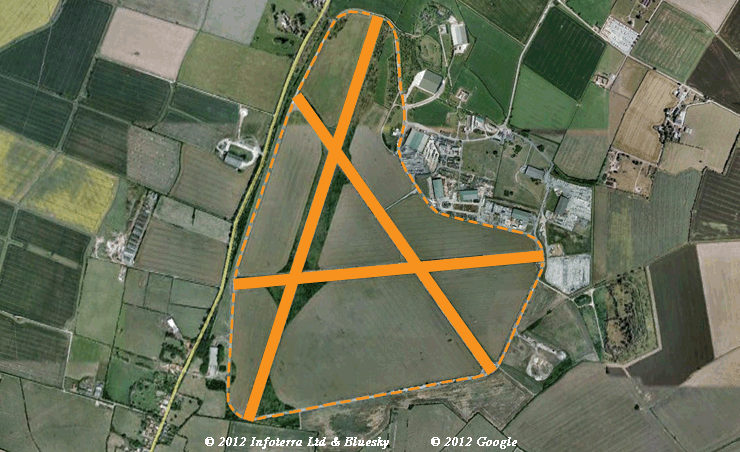
(Map edited to show runways)


Airfield Code: X3BV

USAAF Station: 481

Google Earth Co-ordinates:  52°57'54"N     00°46'54"W

Runways: 01/19 = 6000ft x 150ft    08/26 = 3600ft x 150ft     14/32 = 3000ft x 150ft


Six miles north-west of Grantham, on the eastern side of the Bottesford to Long Bennington road, Bottesford was located partly in the parishes of Normanton and Long Bennington, straddling the Lincolnshire-Leicestershire border. As Normanton was the nearest village, the airfield became known locally by that name, although the official name was Bottesford after the larger village 11 miles to the south.

Intended as a parent station the ground support station was constructed largely of Nissan huts of various sizes and larger than most USAAF stations. The support station was where the group, ground station commanders, squadron headquarters and orderly rooms were located. Also on the ground station were where the mess facilities, chapel, hospital, mission briefing, debriefing, armory, life support, parachute rigging, supply warehouses, station and airfield security, motor pool and the other ground support functions necessary to support the air operations of the group. These facilities were all connected by a network of single path support roads.

Built by George Wimpey & Co. Ltd from November 1940, it had concrete runways from the outset, one of the first in the area to do so. The main 0l-19 was 1700 yards long, the 08-26 1200 yards and the 14-32 1300 yards. However, the main runway was extended to 1933 yards, the 08-26 to 1460 yards and the 14-32 to 1510 yards before the airfield was completed. Thirty-six pan hard standings were provided, one grouping being located on the other side of the Bottesford Bennington road. Five of the dispersals were lost when the hangars were erected. The main technical site was situated on the northeast side and dispersed domestic sites in fields towards the Al trunk road. A Type T2 hangar was located on the technical site and another on the south-west corner of the airfield. Later a B1 for Ministry of Aircraft Production engineers was erected on the west side of the Bottesford-Bennington road with an access strip to the perimeter track. Bomb stores and armoury were on the east side in Noss Plantation near Big Grange. The dispersed camp sites, 11 domestic, two communal and a sick quarters providing for a maximum complement of 2373 males and 462 females was to the north of the airfield.

The airfield became operational in November 1941 with the arrival of No.207 Squadron, 5 Group, Bomber Command, from RAF Waddington. This squadron, the first to be equipped with the troublesome Manchester, However because of continual difficulties experienced with their Vulture engines. operations were frequently curtailed, but in March 1942 the squadron was able to step up its bombing raids on Germany when it became one of the first to receive the new Avro Lancaster in March 1942. No.207 Squadron moved to RAF Langar in September 1942, presumably to escape further construction work, which included the erection of two more T2 hangars. In November 1942, No.90 Squadron was re-formed at Bottesford to fly Stirlings in 3 Group and departed for RAF Ridgewell the following month before becoming operational. A new Australian manned squadron, No.467 Squadron, arrived in November 1942 commencing operations on the night of January 2/3, 1943.

Two more T2 hangars were erected near the technical site in 1943 specifically to protect Horsa gliders from inclement weather as Bottesford was the recipient of over 50 of these wood and canvas craft in preparation for the cross-Channel invasion. In November 1943, No.467 Squadron was moved out to RAF Waddington as Bottesford had been allocated to the USAAF's IX Troop Carrier Command for the forthcoming operation. Work started immediately on providing more hard standings, 21 loops being added in two clusters on the west side of the Bottesford-Bennington road. In the course of this work, five of the pans were destroyed. The fifty six C-47s of the 436th Troop Carrier Group arrived in January 1944 and moved on in March to be replaced by the 440th TCG fresh from the USA. Each squadron was equipped with 14 aircraft. In late January 1944, a school was set up for training C-47 navigators in the use of "Gee" navigational aid, the school moving to more ample quarters at RAF Cottesmore in February 1944. This group also moved south during the following month and Bottesford was then used for glider repair and modification. On 26th April the 440th moved south to RAF Exeter as part of the general move of the groups of the 50th TCW to obtain better operational deployment. After using the airfield during the following two months for glider repair and modification, the USAAF then departed.

The USAAF relinquished Bottesford to No. 5 Group Bomber Command in July 1944. 1668 Heavy Conversion Unit with Lancaster’s arrived and later some specialist flights were also based at the station with a variety of aircraft types. In November, 1668 HCU was re-assigned to No. 7 Training Group. Bottesford remained a Lancaster training station until the late summer of 1945, 1668 HCU moving to more comfortable accommodation at RAF Cottesmore in September. Thereafter little flying took place although the hangars were used for storage by the Air Ministry. A holding party remained for a few years but the airfield was in agricultural use by 1948 and a civilian warehousing operation was established in the hangars by John Rose, whose company was formed in 1954, and who purchased most of the airfield in 1962. The Roseland Group Ltd continues to operate from the site and uses the restored control tower as the company's office.

RAF Bomber Command operational losses sustained by the units based at Bottesford amounted to three Manchester’s and 55 Lancaster’s, a total of 58.

With the facility released from military control, farmers were using the land for crops. Today, the technical site buildings are operated as an industrial facility, possibly an automotive assembly plant. Large numbers of new automobiles are stored on the former runways, all of which still exist with just a small amount of concrete (mostly dispersal loops) being removed for hardcore. The perimeter track and two T2 hangars still exist, being used for unknown purposes, although the condition of the perimeter track is very deteriorated.


Aircraft & Squadrons

Date
Sqn
Notes
September 1941
 
Station opens.
November 1941
No.207 Sqn
RAF
Operating the Avro Lancaster. Left Bottesford in September 1942.
October 1942
No.90 Sqn
RAF
Operating the Shorts Stirling. Left Bottesford in December 1942.
November 1942
No.467 Sqn
RAF
Operating the Avro Lancaster. Left Bottesford in November 1943.
January 1944
 
RAF transferred the station to the USAAF.
January 1944
436th TCG
USAAF
Operating the Douglas C-47 Skytrain. Left Bottesford in March 1944.
March 1944
440th TCG
USAAF
Operating the Douglas C-47 Skytrain. Left Bottesford in April 1944.
July 1944
 
USAAF transferred the station back to the RAF.
July 1944
1668 HCU
RAF
Operating the Avro Lancaster. Left Bottesford in September 1945.
September 1944
1321 BDT
RAF
The Bomber Defence Training Flight left Bottesford in November 1944.
September 1945
 
Station closed and placed on care and maintenance.
August 1947
No.1 FTS
RAF
The Flight Training School left in February 1948.
January 1949
93 MU
RAF
The Maintenance Unit left Bottesford in January 1959.
January 1959
92 MU
RAF
The Maintenance Unit left Bottesford in March 1960.
1962
 
RAF Bottesford completely sold off.


Back to the top