Faldingworth Airfield History
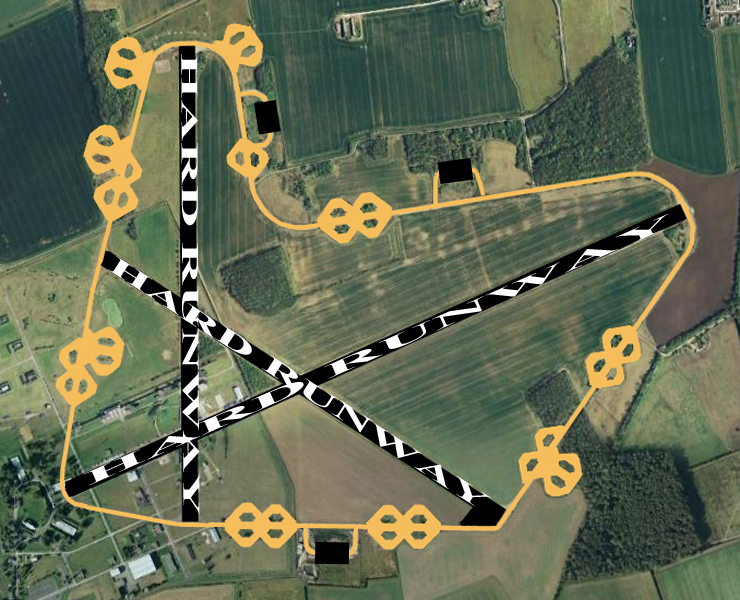
(Map edited to show the airfield and runways between 1940-45)
© Crown Copyright/MOD 2010
53°21'15.98"N 0°26'56.00"WRunways:
01/19 & 13/31 4200ft x 150ft - 07/25 6000ft x 150ft
Located only 1 mile from Faldingworth church and also close to the village of Newtoft, the site chosen for what would become RAF Faldingworth was originally a decoy site for RAF Hemswell known as Toft Grange.
Construction began on the airfield on the 1st August 1942. As with other airfields of the time period, it would be built to the Class ‘A’ standard. This consisted of three runways intersecting each other and surrounded by the peri-track. The technical site along with both the accommodation and communal were built on the northern side of the airfield. The normal three hangars (two T2s and a B1) were erected, with one T2 being built off the southern peri-track and the remaining T2 and B1 being built on the off the northern peri-track. Although the airfield opened on the 5th July 1943, it was not officially opened until 27th July, even though the airfield was still incomplete.
Immediately upon opening the station was placed under the control of 1 Group Heavy Conversion Base, to be used as a satellite. Despite some of the facilities still not being complete, the stations first residents arrived on the 8th August 1943 in the form of 1667 HCU. They in turn brought with them the airfields first aircraft, the Handley Page Halifax and the Avro Lancaster. No sooner had the wheels touched the ground, when the first course started on the 11th August.
The next addition the airfield was No.1 LFS ‘C’ Flight being formed on the 21st November 1943. This new flight was made up of the Lancaster flight from 1667 HCU. This in turn led 1667 HCU to become an all Halifax conversion unit having thirty-two aircraft at its disposal. More change was on the way for Faldingworth, but this time in form its control. The airfield was upgraded to a sub-station of 14 Base, under the control of Ludford Magna on the 23th January 1944. This change led to No.1 LFS ‘C’ Flight leaving Faldingworth for pastures new the following day. The change of control also led to 1667 HCU leaving the station, with ‘A’ Flight leaving first on the 18th February 1944, followed the next day by both ‘B’ and ‘C’ Flights. But it wasn’t long before they were replaced with the stations first all-out operational squadron, No.300 (Mazowiecki) Squadron, Polish Air Force.
The heavy bomber squadron arrived on the 1st March 1944, bringing with them the Avro Lancaster. The squadron had been using the Vickers Wellington at its previous posting, but instantly converted to the Lancaster on their arrival at Faldingworth. The following month saw another new flight stand-up at Faldingworth, No.1546 BAT (Beam Approach Training) Flight on the 8th May 1944. The flight was originally scheduled to be formed over the border at Gamston, but due to lack of space there they switched to Faldingworth. The flight was also to bring a new aircraft type to the airfield, in the form of the Airspeed Oxford.
By now more and more personnel where flooding in the station, and on the 12th June, a second flight for No.300 Squadron was formed. But instead of it being manned by Polish personnel, it was manned by English personnel until enough Polish personnel were available to replace them.
Another new squadron was to arrive at the airfield on the 7th October 1944, No.166 ‘C’ Flight. Their arrival was due to the formation of No.153 Squadron at Kirmington. No.153 Sqdn had taken the majority of personnel from No.166 thus leaving the squadron short, so the decision was taken to bolster No.166 Sqdn with a new flight. But their stay was short lived and no sooner had the new flight been established, then they were moved on to join the rest of No.166 back at Kirmington.
The rest of the year remained uneventful in terms change, but the New Year immediately brought a change. The decision was made to disband 1546 BAT Flight and on the 9th January 1945 they were gone. This in turn left only No.300 Sqdn as the only residents at what was once heaving airfield.
With the end of the war No.14 Base was disbanded, which left the airfield as an independent station. But despite the change, No.300 Squadron continued to operate from the airfield, taking part in to post-war operations in the form of Operations Dodge, Manna and Exodus. But as with many airfields around the country, the end of the war also signalled the end for many airfields, Faldingworth being no exception.
No.300 Squadron were eventually disbanded on the 11th October 1946, but instead of the airfield being placed on Care and Maintenance, they were replaced with the arrival of No.305 Squadron, Polish Air Force. They arrival not only brought new aircraft the airfield in the shape of the de Havilland Mosquito, but also new hope that the station would survive. But this was short lived, when on 6th January 1947 No.305 Squadron were disbanded, and the station placed on Care and Maintenance.
It wasn’t until April 1949 that the airfield would see change again, when control was transferred from Bomber Command to 42 Group Maintenance Command. The intended use for the airfield was to be a sub-site for 93 MU, and they remained in control until October 1957. Then in the same month 92 MU was formed at the airfield and the airfield was partially reactivated again, but not for its previous use as a flying airfield. This time the station was be tasked with the supply of munitions to all other RAF airfields in Lincolnshire. This also included the storage of Nuclear weapons during the Cold War period. But the end was near for Faldingworth and in November 1972, 92 MU were disbanded and the airfield closed and placed up for sale.
Shortly after closing the accommodation blocks at the airfield were used for a short period as housing for a number of displaced Ugandan Asians, but by the end of 1973 they had been moved on. After they had left the station slowly began to be returned to its original use as farmland, until finally in 1998 the main part of the station was sold-off.
Today much of the former RAF station has been completely returned to farmland, but the old munitions site still remains active, all be in it in a civilian capacity. The former munitions site was bought by a civilian company in 1972 which specialises in explosive’s testing, along with other munitions testing. Access to this part of the airfield is restricted so it is not entirely known how much of the original buildings remain, but it is thought that structurally at least they are pretty much untouched.
As for the rest of the airfield, a number of buildings still remain on the northern side. The former station sick quarters and cinema can still be seen, along with one of the B1 hangars, also along with the footings of a few other buildings. A memorial has also been erected on the eastern side of the airfield commemorating the personnel that once served at this proud station.
| Date | Squadron | Notes |
|---|---|---|
| July 1943 | Station opened | |
| August 1943 | 1667 HCU | Operating the Handley Page Halifax and Avro Lancaster. The heavy Conversion Unit left the station on the 19th February 1944. |
| November 1943 | No.1 LFS 'C' Flight | Operating the Avro Lancaster. The Lancaster Flying School left the airfield on the 24th January 1944. |
| March 1944 | No.300 Sqdn Polish AF | Operating the Vickers Wellington and Avro Lancaster. The squadron was disbanded at Faldingworth on the 11th October 1946. |
| May 1944 | No.1546 BAT Flight | Operating the Airspeed Oxford. The Beam Approach Training Flight disbanded at Faldingworth on the 9th January 1945. |
| October 1944 | No.166 Sqdn 'C' Flight | Operating the Avro Lancaster. The flight left the station on the 15th October 1944. |
| October 1946 | No.305 Sqdn Polish AF | Operating the de Havilland Mosquito. The squadron disbanded at Faldingworth on the 6th January 1947. |
| January 1947 | Station placed on Care and Maintenance. | |
| April 1949 | No.93 MU | The Maintenance Unit left the airfield in October 1957. |
| October 1957 | No.92 MU | The Maintenance Unit disbanded at Faldingworth in November 1972. |
| November 1972 | RAF Faldingworth closed. | |
| 1998 | The main part of the airfield sold-off. |

