Wickenby Airfield History
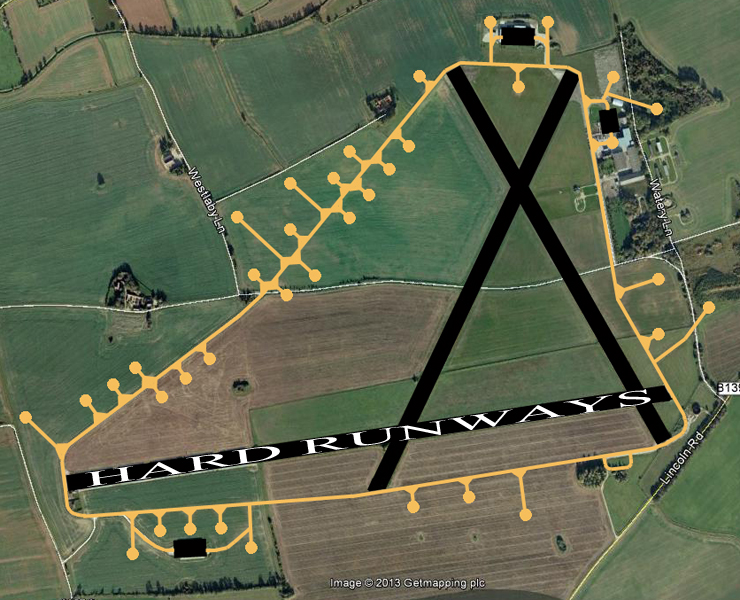
(Map edited to show the airfield and runways between 1940-45)
© Crown Copyright/MOD 2010
53°18'51.8"N 0°20'57.2"WRunways:
03/21 1739ft x 59ft - 16/34 1631ft x 59ft
Wickenby airfield is located 2.5 miles north-west of Wragby, north of the B1399 and just west of Holton cum Beckering. The airfield opened in the summer of 1942, within 1 Group. It was built to Class 'A' standard with three hangars. One T2 was located on the perimeter track, a second T2 was located off the northern perimeter track and B1 was added later to the south-west of the airfield, beyond which were the bomb stores. The communal and accommodation sites were dispersed south of the airfield, and in woodland to the east.
On 25th September 1942, No.12 Squadron arrived from Binbrook with their Wellingtons, converting onto Lancasters in November. On 7th November 1943, 626 Squadron was formed from 'C' Flight of No.12 Squadron. Both squadrons operated from the airfield until the end of the war, No.12 Squadron moved to Binbrook on 24th September 1945, and No.626 Squadron disbanded at Wickenby on 14th October 1945. Arriving on 19th October 1945 was No.109 Squadron, equipped with Mosquitos. Their stay was short and they left for Hemswell on 27th November. The airfield was retained by the RAF and used as an explosive store and disposal facility until the mid 1950s.
Today, Wickenby is a very active general aviation airfield, operated by Lincoln Aviation Ltd. The flying club use the northern parts of the two subsidiary runways, and are based in the watch office. Also in the watch office is the RAF Wickenby Memorial Collection, which includes Wickenby Museum and the Wickenby archive. The B1 hangar still stands and the northern T2 hangar is still in use, supplemented with modern additions. Some of the communal and accommodation buildings can still be seen, although most are in a deteriorating state and are on private land. A the entrance to the flying club there is a memorial to No.12 Squadron and No.626 Squadron, which features a sculpture of Icarus.
For more information on the RAF Wickenby Memorial Collection, please click here
| Date | Squadron | Notes |
|---|---|---|
| 1942 | Station opens. | |
| September 1942 | No.12 Sqn | Operating the Vickers Wellington and Avro Lancaster. The squadron left Wickenby on 24th September 1945. |
| November 1943 | No.626 Sqn | Operating the Avro Lancaster. The unit was disbanded at the station on the 14th October 1945. |
| October 1945 | No.109 Sqn | Operating the de Havilland Mosquito. The squadron left the station on 26th November 1945. |
| November 1945 | All military flying ceased at RAF Wickenby. | |
| December 1945 | No.61 MU | Left Wickenby in November 1949. |
| October 1948 | No.93 MU | Left Wickenby in January 1951. |
| January 1951 | No.92 MU | The Maintenance Unit disbanded at the airfield in April 1956. |
| 1956 | RAF Wickenby closed. | |
| 1964-66 | RAF Wickenby cleared and sold-off. |

